
Don't Shoot Portland v. Oregon Department of Justice
- Filed: Oct 22, 2026
- Latest Update: Oct 19, 2026

Summary
Don’t Shoot Portland and ACLU of Oregon are two Oregon nonprofits dedicated to advocating for racial justice, police accountability, and the right to protest. In 2024, both organizations submitted public records requests to illuminate how Oregon TITAN Fusion Center (OFTC) works with other law enforcement agencies to monitor and surveil Oregonians engaged in lawful advocacy and protest — including for racial justice.
The OTFC is a federally funded domestic surveillance program housed under the Oregon Department of Justice’s Criminal Intelligence Unit that works closely with federal law enforcement agencies like the increasingly notorious Department of Homeland Security (DHS). The OTFC operates as part of a vast nationwide network of about 80 similar fusion center programs nationwide. For two decades, OTFC has operated with little oversight or transparency while purporting to collect, analyze, and disseminate information about “terrorism” and crime in Oregon. However, the OTFC, like other fusion centers across the country, has a checkered history of abuses.
ODOJ withheld nearly 2000 records from its response — largely the ones it said the ACLU would be “most interested in” — based on its “Third Agency Rule,” which it said requires OTFC to keep records it receives from other agencies confidential. The Petition argues that rule cannot displace ODOJ’s obligations under the Public Records Law.
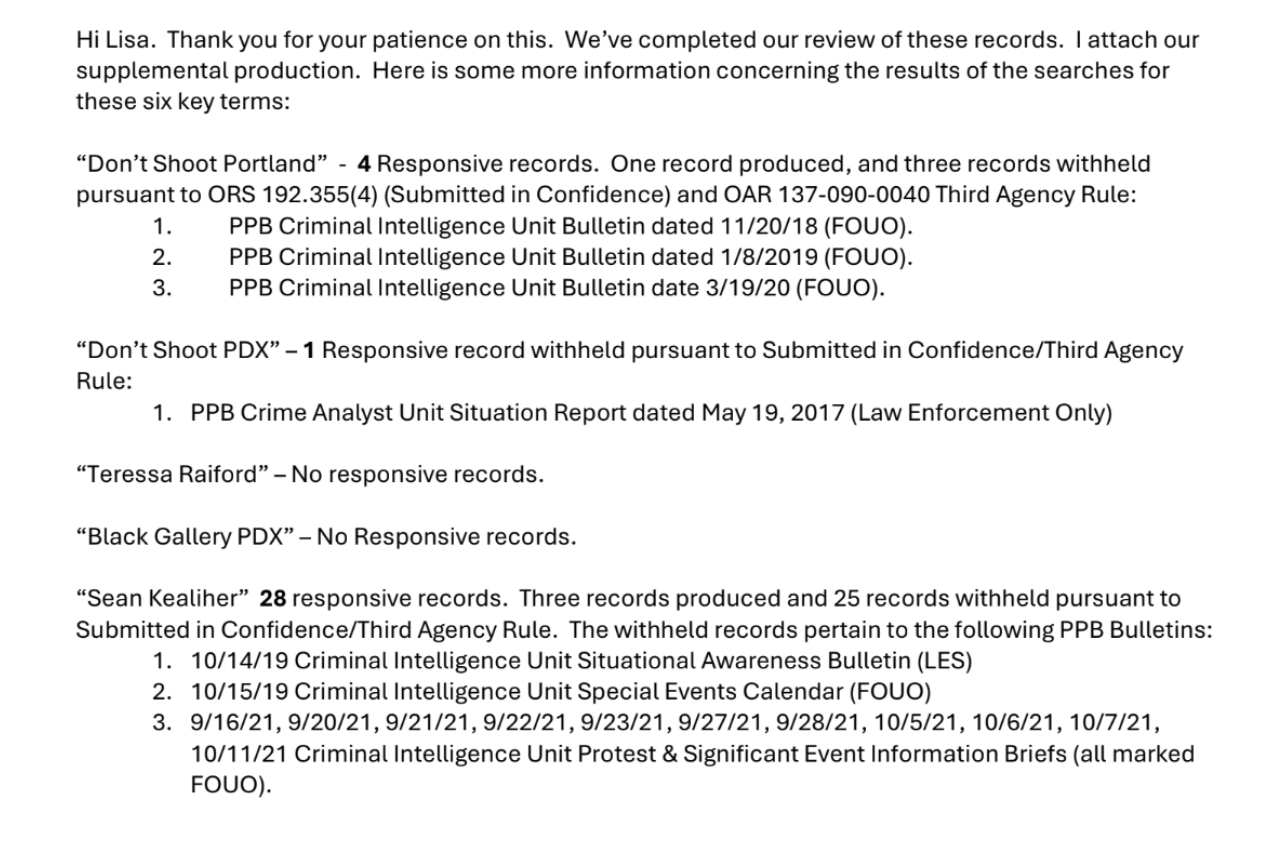
The disputed records include “Criminal Intelligence Unit Bulletin[s]” issued by the Portland Police Bureau that name Don’t Shoot Portland (sometimes referred to as Don’t Shoot PDX) and “Criminal Intelligence Unit Protest [and] Significant Event Information Briefs” that name Sean Kealiher, a founding organizer of Don’t Shoot PDX’s community action plan who was killed in 2019 at age 23. The existence of the records suggests additional evidence of OTFC’s improper surveillance of people and groups engaged in protected political and noncriminal activities.
Plaintiffs urge the Attorney General to reject ODOJ’s reliance on the Third Agency Rule as blanket authority to withhold records from the public. The people of Oregon deserve transparency about how state, local, and federal police cooperation affects their rights and freedoms.
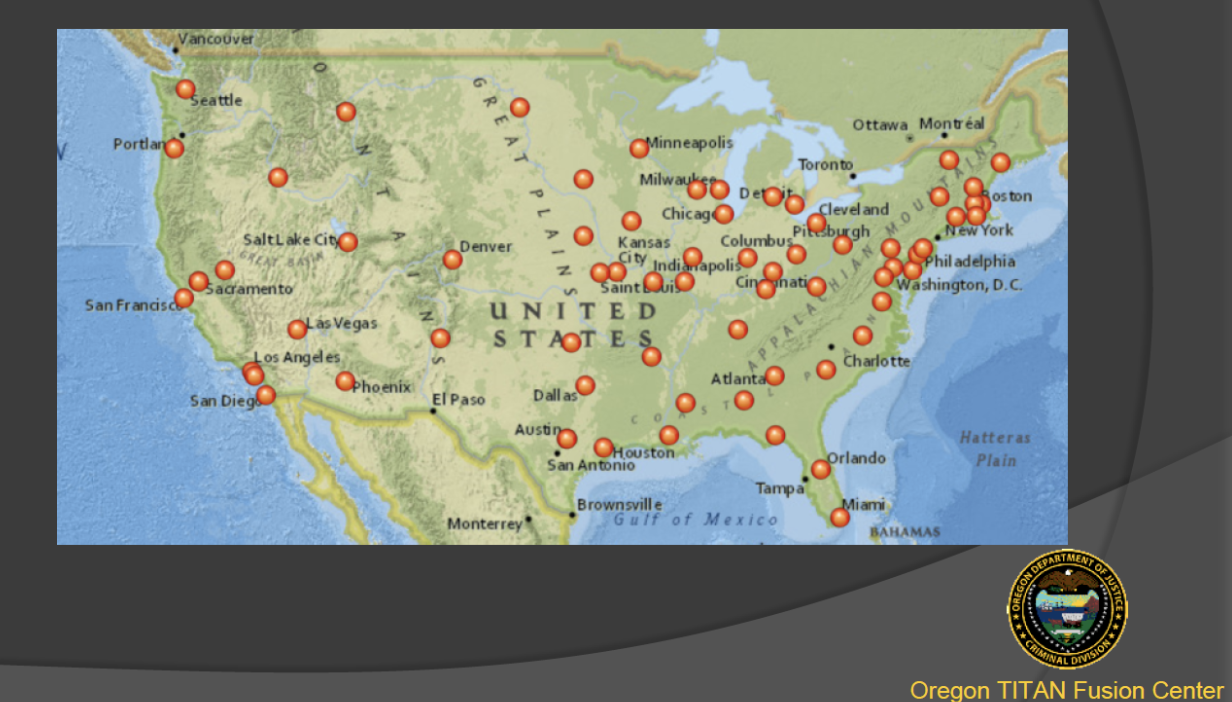
National network of fusion centers in 2017
Don't Shoot Portland v. Oregon Department of Justice Timeline
October 21, 2026
Petition to the Attorney General filed
The ACLU of Oregon and Don’t Shoot Portland petitioned the Oregon Attorney General to review the Oregon Department of Justice (ODOJ)'s refusal to disclose public records relating to the Oregon TITAN Fusion Center (OTFC).
Oregon Court of Appeals issues opinion on 2021 fusion center case
The court in Farrell-Smith et. al. v. Oregon Department of Justice et al. concluded that people suing the Attorney General for operating OTFC without lawful authority have a green light to pursue their lawsuit.
August 14, 2026
Follow-up response to original December 2024 request
ODOJ sends a few additional records that it says should have been included in its response to the original December 12, 2024 records request.
August 3, 2026
Final response to the May 2026 supplemental request
ODOJ shares final logs to complete the May 22, 2026 supplemental request.
July 13, 2026
Partial response
ODOJ shares a further partial response to the May 22, 2026 supplemental request and says it anticipates completing the log on or before August 7, 2026.
June 15, 2026
Partial response
ODOJ responds to the May 22, 2026 supplemental request with a partial response. ODOJ states they are working to create logs of all records withheld pursuant to the third agency rule including the date, title, and originating agency of the records. ODOJ states that it did not ask any of the originating agencies to reconsider whether documents could be released in connection with the ACLU of Oregon’s original request.
June 2, 2026
Partial response
ODOJ makes partial production responsive to ACLU of Oregon’s email from May 12, 2026 (relating to specifically identified people and organizations). In that communication, ODOJ reports that it is withholding 29 additional records pursuant to ORS 192.355(4) and OAR 137-090-0040. ODOJ states that this production completes its response to the December 12, 2024 records request.
May 22, 2026
Supplemental records request
The ACLU of Oregon submits a second follow-up records request concerning ODOJ’s asserted third agency rule withholdings to see if they followed the process laid out in their own rule and to identify the originating agency of each withheld record.
May 12, 2026
Following up
The ACLU of Oregon asks ODOJ to provide more information about records withheld concerning Don’t Shoot Portland, Teressa Raiford, Black Gallery PDX, Sean Kealiher, and the ACLU of Oregon.
April 27, 2026 and May 7, 2026
Partial response and exemptions
ODOJ releases additional records, redacting some information “under ORS 192.345(22) (interference with property or services), ORS 192.345(23) (security measures), ORS 192.355(1) (internal advisory communications), ORS 192.355(4) (information submitted in confidence), and the Third Agency Rule, OAR 137-090-0040.” The records do not indicate which claimed exemptions apply to which redactions.
April 14, 2026
Delayed response
ODOJ says it needs an additional 30 days to complete its review, due to staff availability, but that it would make rolling productions as records were cleared for disclosure.
March 13, 2026
Partial response
ODOJ produces more records, but still only provides another partial response.
February 20, 2026
Delayed response
ODOJ says that limited staff availability required an extension to March 13.
February 6, 2026
Delayed response
ODOJ indicates it needs until February 20 to complete the request.
January 9, 2026
Partial response
ODOJ sends a partial response and states that it would complete its production by February 6.
November 13, 2025
Partial response
ODOJ produces another partial response.
October 20, 2025
Partial response
ODOJ says it is still working through the review and would only be making a partial response.
October 15, 2025
Delayed response
ODOJ reports that it would be making the production on October 20.
September 23, 2025
Delayed response
ODOJ responds that the review is “almost done.”
September 19, 2025
Status check
The ACLU of Oregon checks in again on the status of the request.
July 15, 2025
Delayed response
ODOJ estimates that it would take another 6 - 8 weeks to complete its review and response.
July 9, 2025
Status check
The ACLU of Oregon checks in on the status of the request.
May 30, 2025
Payment confirmed
ODOJ confirms receiving payment for the records and states it will begin review.
May 13, 2025
Third Agency Rule exemption and costs
ODOJ reports that the narrowed request returned 6,362 records and estimates production will cost the ACLU Oregon $3,392. However, ODOJ states it would be producing “far fewer” than the total number of records due to a significant number of records being exempt because, “they consist of information reported by other law enforcement agencies, which the fusion center is required to keep confidential.” The ACLU of Oregon agrees to submit payment.
March 25, 2025
Narrowed request
ODOJ discloses some records in an initial partial response including TITAN Fusion Center’s privacy policy, training materials, and other information. In the email, ODOJ states that it “anticipate[s]” many of the documents the ACLU and Don't Shoot PDX would be "most interested in" would likely be exempt pursuant to ORS 192.355(4) and the “Third Agency Rule” and that, “the public interest in operating a functional fusion center would suffer if it violated the so-called “third agency rule” and disclosed the reports.”
The ACLU of Oregon agrees to begin with a more narrow set of responsive records concerning “Don’t Shoot Portland,” “Don’t Shoot PDX,” “Black Gallery PDX,” “Teressa Raiford,” “Sean Kealiher,” and “ACLU of Oregon” and records including the terms “Black identity extremist,” “Black identity extremism movement,” “domestic terrorism,” and “environmental violent extremism.”
January 24, 2025
Meeting with OTFC
ODOJ and the ACLU of Oregon meet to discuss the scope of the request. The ACLU of Oregon urges that they would still like to move forward with the request.
January 2, 2025
Proposal to meet
ODOJ proposes to meet with the ACLU of Oregon legal team to, “to clarify certain portions of your public records request, explain what the ODOJ’s TITAN Fusion Center does, and why we will not have all responsive records you are seeking.”
December 24, 2024
Request under review
ODOJ informs the ACLU of Oregon that the request is still under review.
December 17, 2024
Request received
ODOJ acknowledges receipt of the records request and says it will conduct a search and respond as soon as practicable.
December 12, 2024
Public records request submitted
The ACLU of Oregon in partnership with Don’t Shoot Portland submits a public records request to the Oregon Department of Justice to identify how the Oregon TITAN Fusion Center monitors and collects information on people engaged in protest activity and/or associate protest with “terrorism,” and to obtain records concerning Don’t Shoot Portland, Don’t Shoot PDX, Black Gallery PDX, Teressa Raiford, Sean Kealiher, and ACLU of Oregon.
Documents
- Oct 21, 2026 Petition for Public Records Disclosure Order
Date Filed: Oct 21, 2026
Affiliate: OR
Download documentPress Releases
Learn More About the Issues in This Case
Related Content

Portland Police Public Records Project

Protecting Your Rights Against Unlawful Police Surveillance
Stay Informed
Sign up to be the first to hear about how to take action.
By completing this form, I agree to receive occasional emails per the terms of the ACLU’s privacy statement.
By completing this form, I agree to receive occasional emails per the terms of the ACLU’s privacy statement.